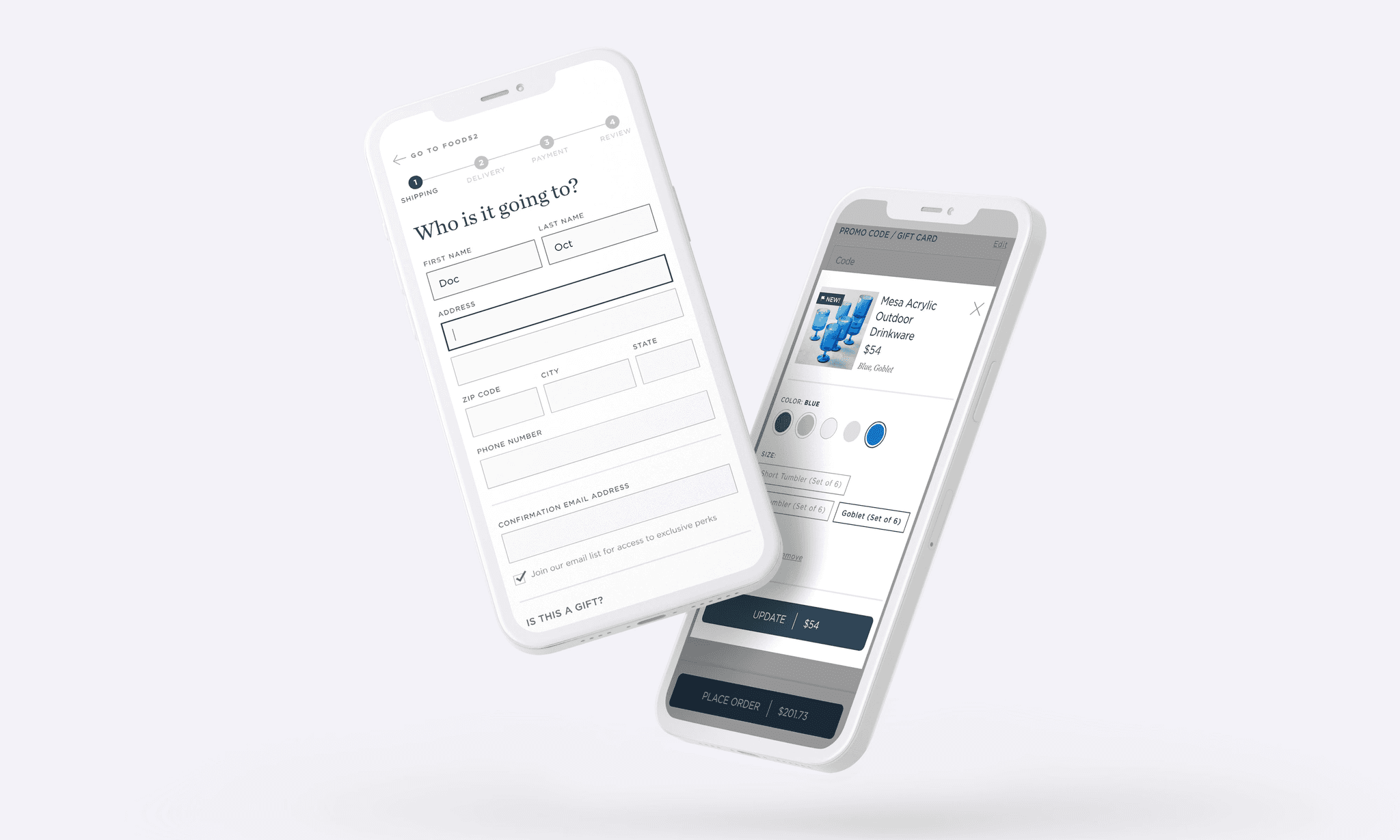
Build trust by bridging the gap between aggressive OKRs and human-centric ux/ui
The Opportunity
While Food52 saw high content engagement, the checkout experience was a point of significant friction. As users transitioned from high-end editorial content to a complex drop-shipping logistics flow, "purchase confidence" plummeted. I was tasked with evolving the UX to bridge the gap between luxury brand sentiment and functional e-commerce reliability.
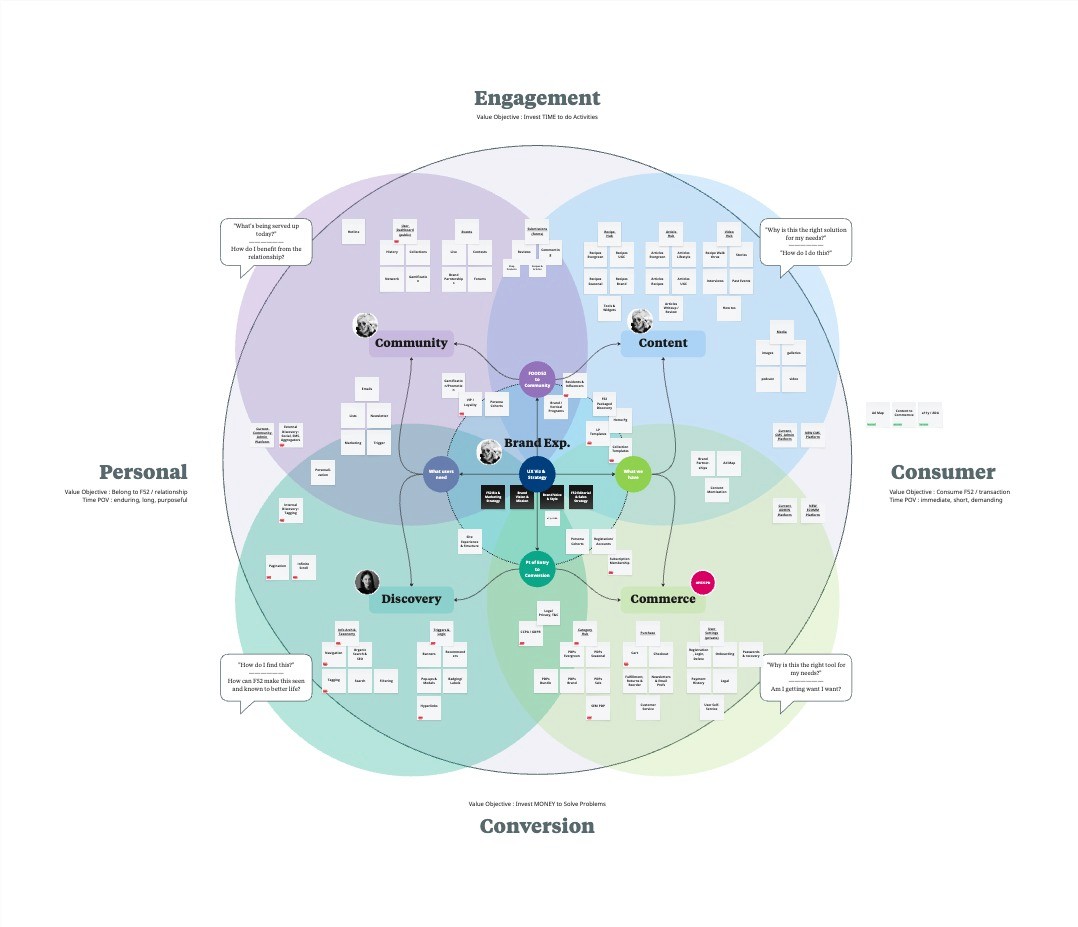
To bring user-based conversations out of ambiguity and assumptions with executives, I created a mind-map diagram show how E-comm fit into the overall business as it accounted for 80% of our overall revenue.
The Problem
Our check was not being used. High bounce rates and churn within the checkout flow and a low retention rate, created an opportunity to iterate on the over all checkout experience.
We were driving users to the revenue flows but losing them in the conversion funnel.
Users did not trust our checkout because it broke the perceived (and well established) ux rules of digital shopping - creating doubt, second-guessing and abandonment. (lack of clarity, complex language, decision making when commitment should be the focus.)
The Users
"I need to just have blind faith that I will get what I am ordering"
I completed a 1 week interview sprint with users, applying a 3-dimensional framework to validate my theories
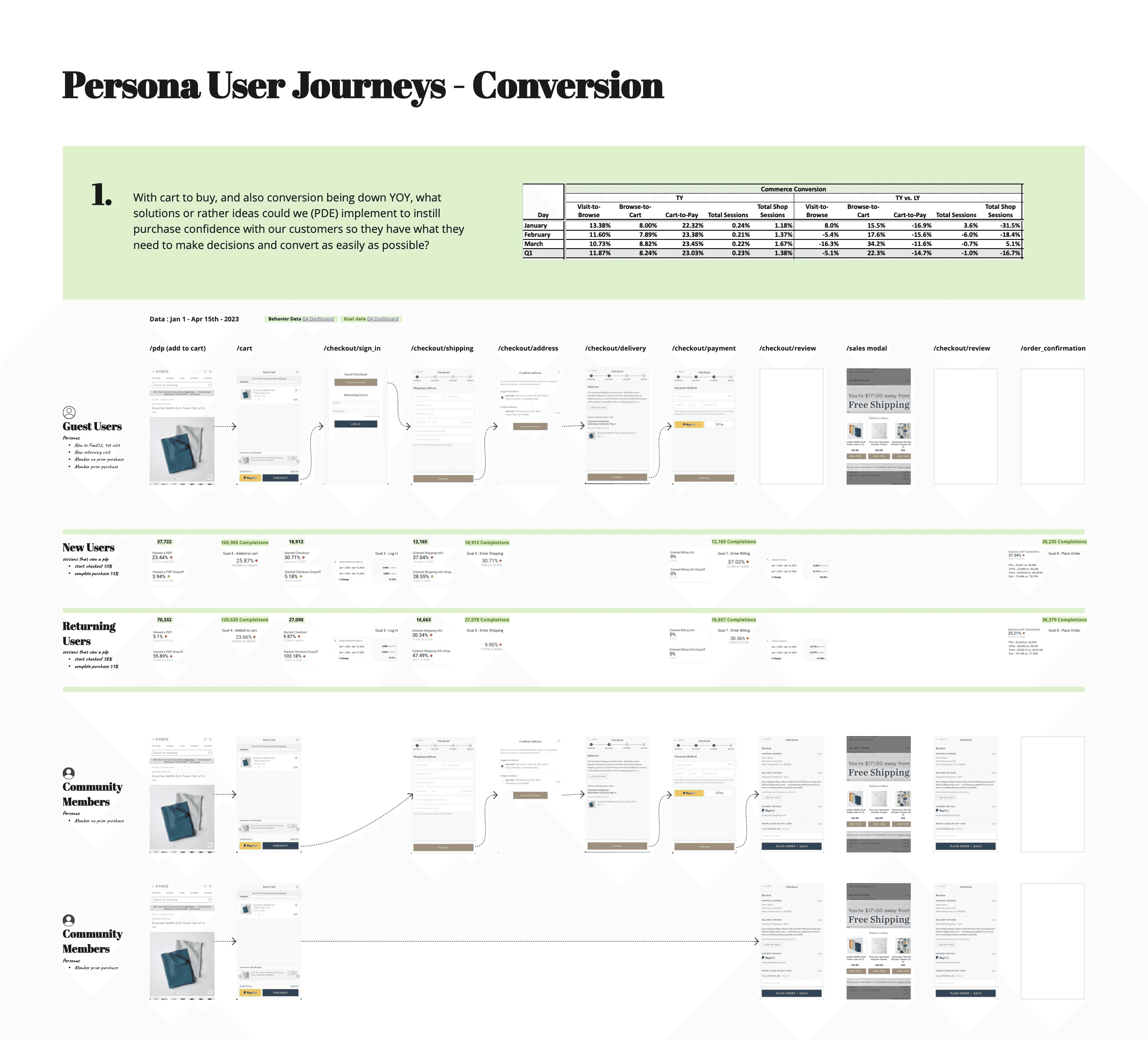
Primary focus on the new visitor (80% of visits) on mobile devices (85% of traffic). Through interviews and quantitative data, I quickly identified the key pain-points and validate my hypothesis based in user confusion in a common task workflow based on desired action and outcomes.
The Challenges
5-15% retention rates
$50-120 loss in checkout abandonment
15-20% completion rates
-28% W3C legal Compliance Score
The Strategy
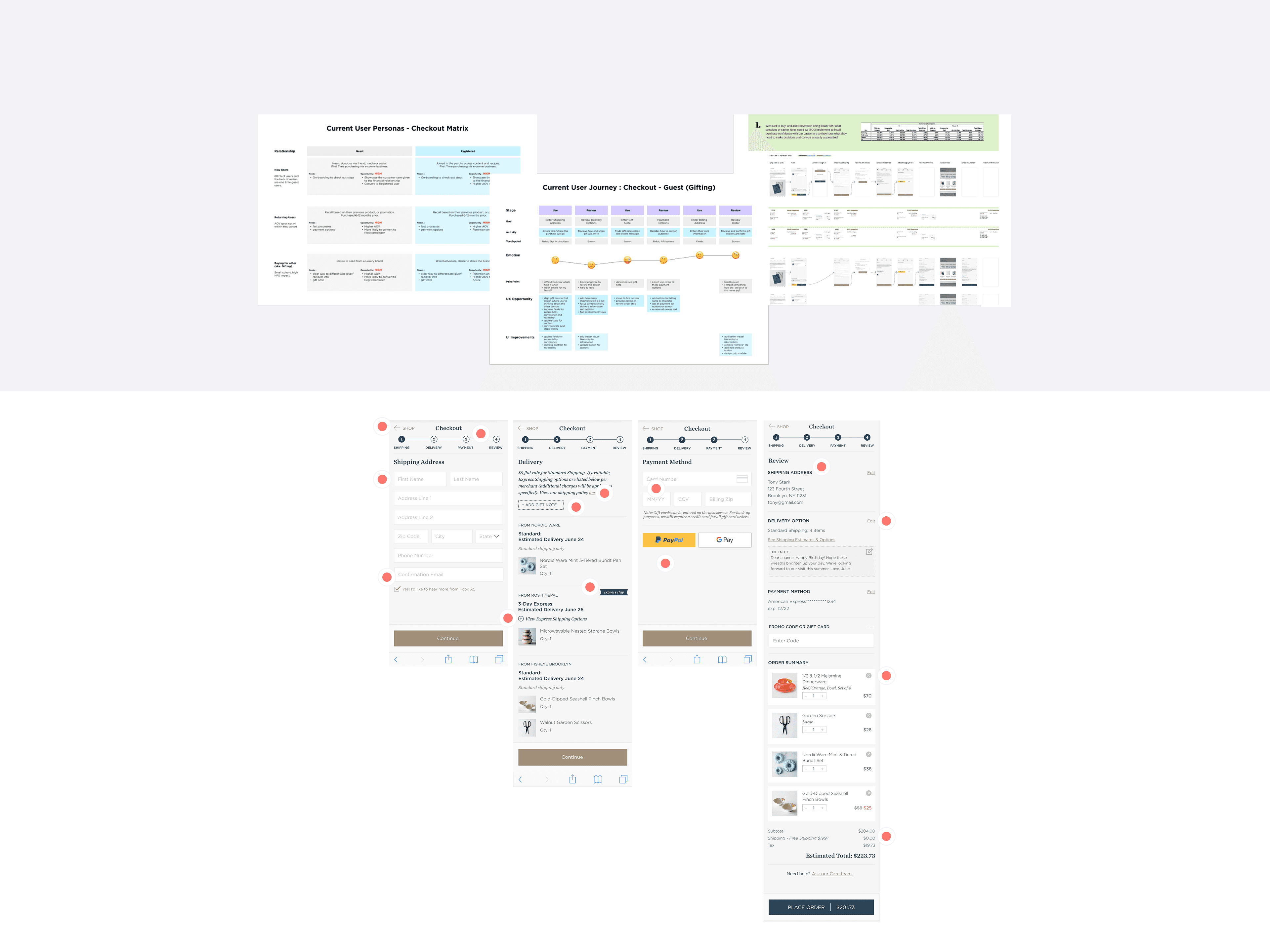
To move from "blind faith" to "informed trust," I facilitated a cross-functional design sprint with Product, Engineering, and Marketing. We mapped the e-commerce ecosystem against five distinct user archetypes and identified four strategic pillars:
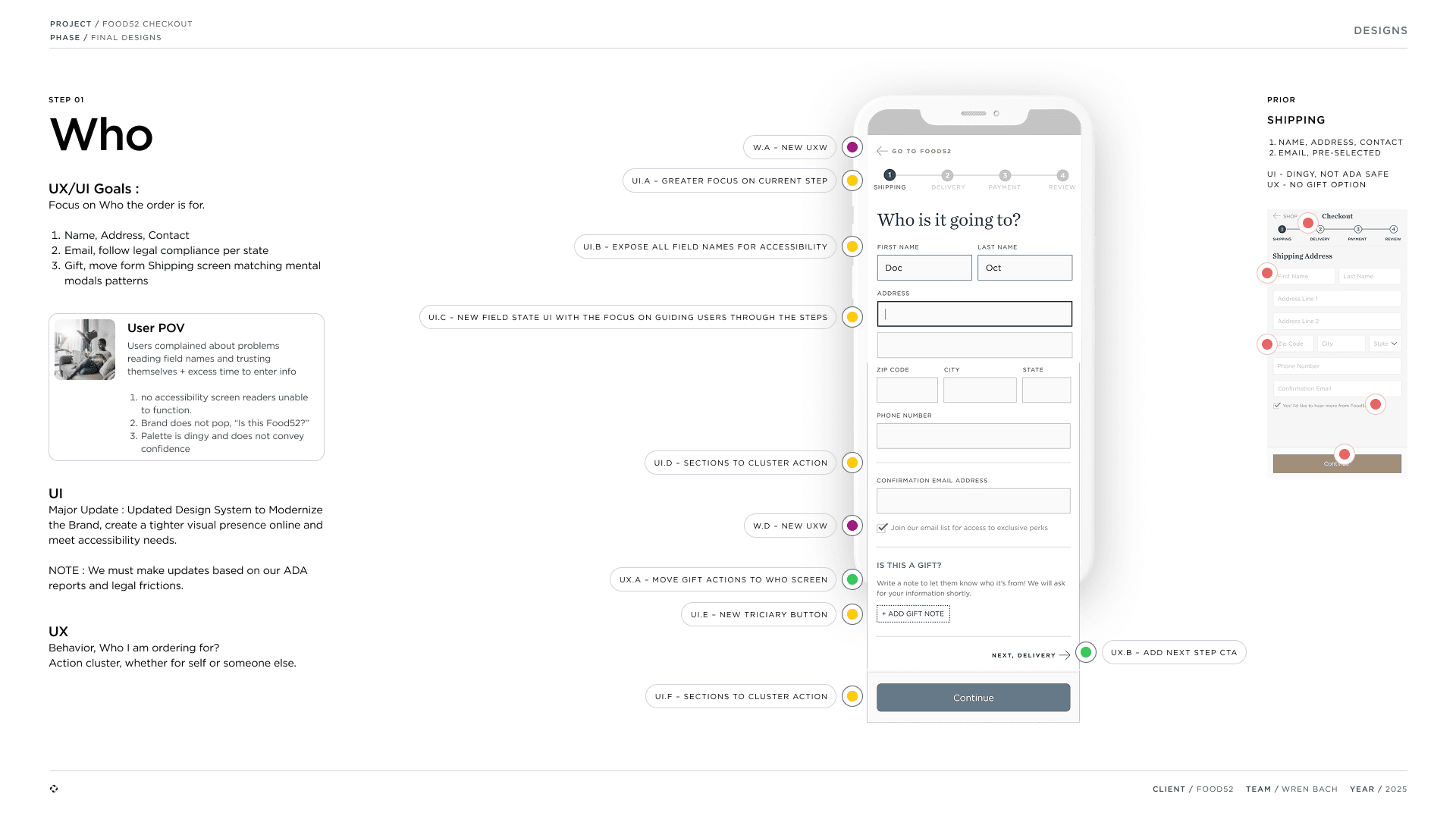
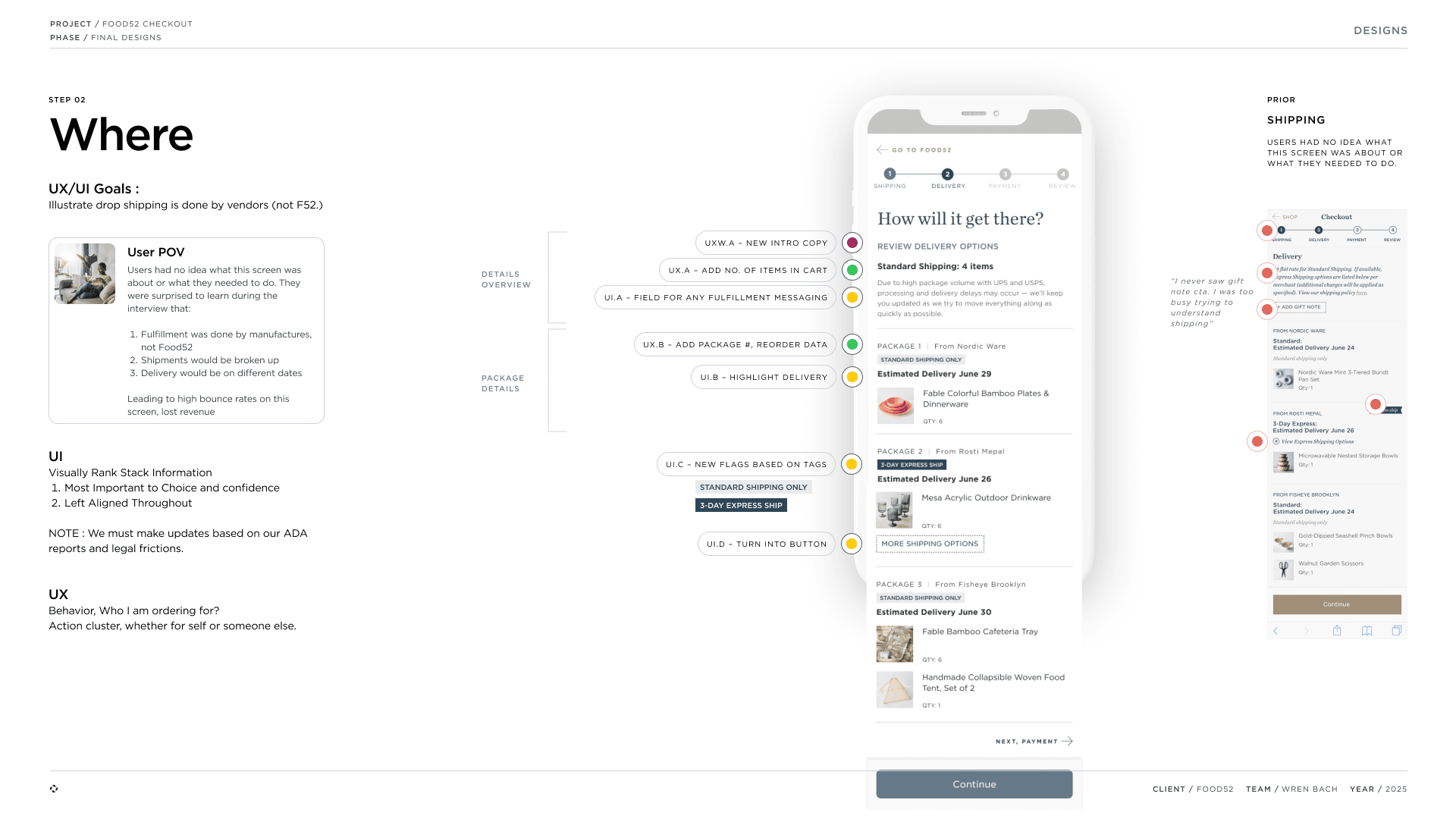
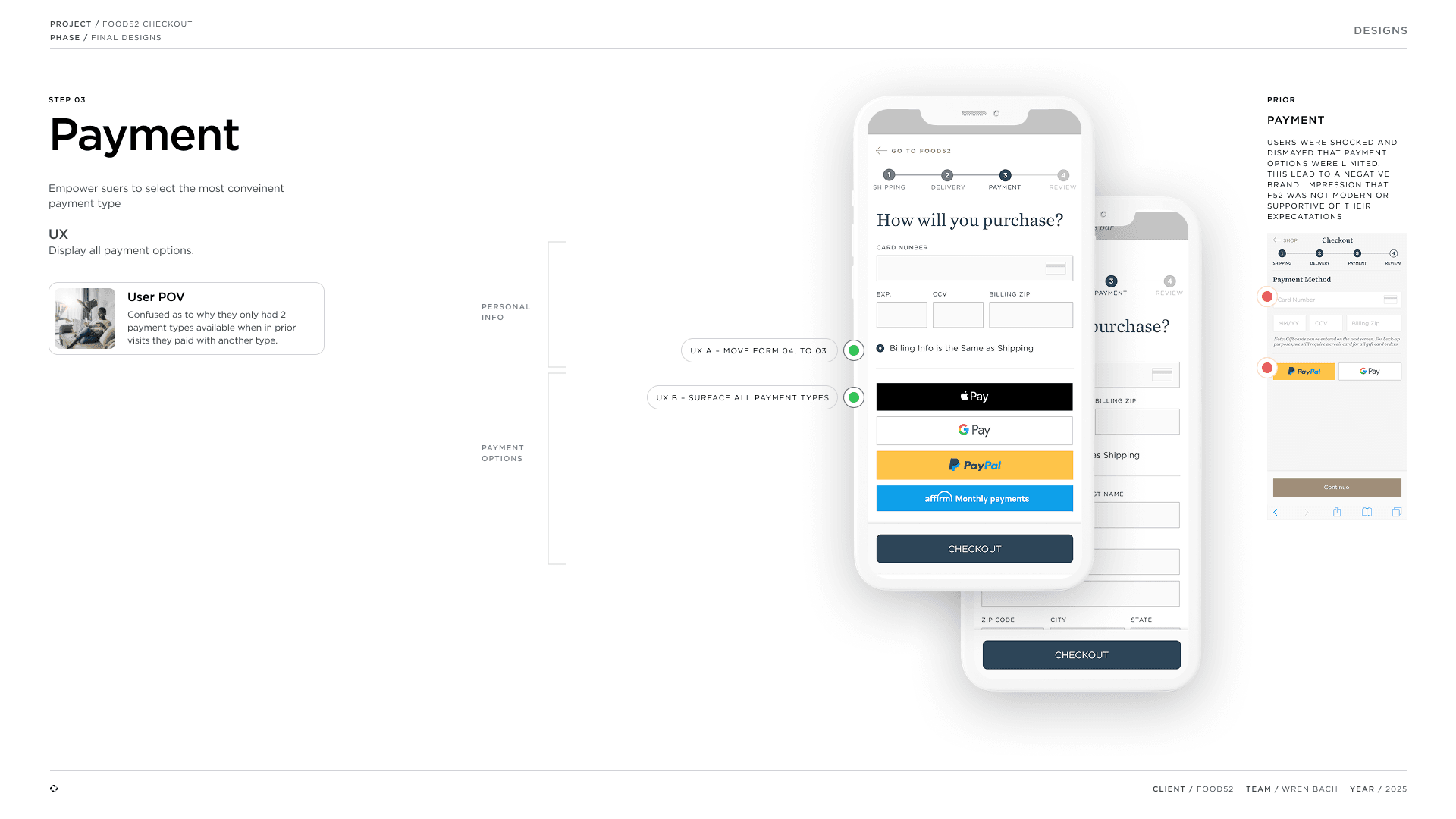
Transactional Clarity: Implementing a high-hierarchy "mini-funnel" (Identity, Shipping, Payment, Review).
Intent-Driven Content: Rewriting technical logistics jargon into human-centric, brand-aligned copy.
Systemic Refinement: Architecting an ADA-compliant design system to reduce cognitive load and visual noise.
Reduce Errors: Redesign UI elements to reduce confusion, errors and support desirability in exclusive purchases
The Execution
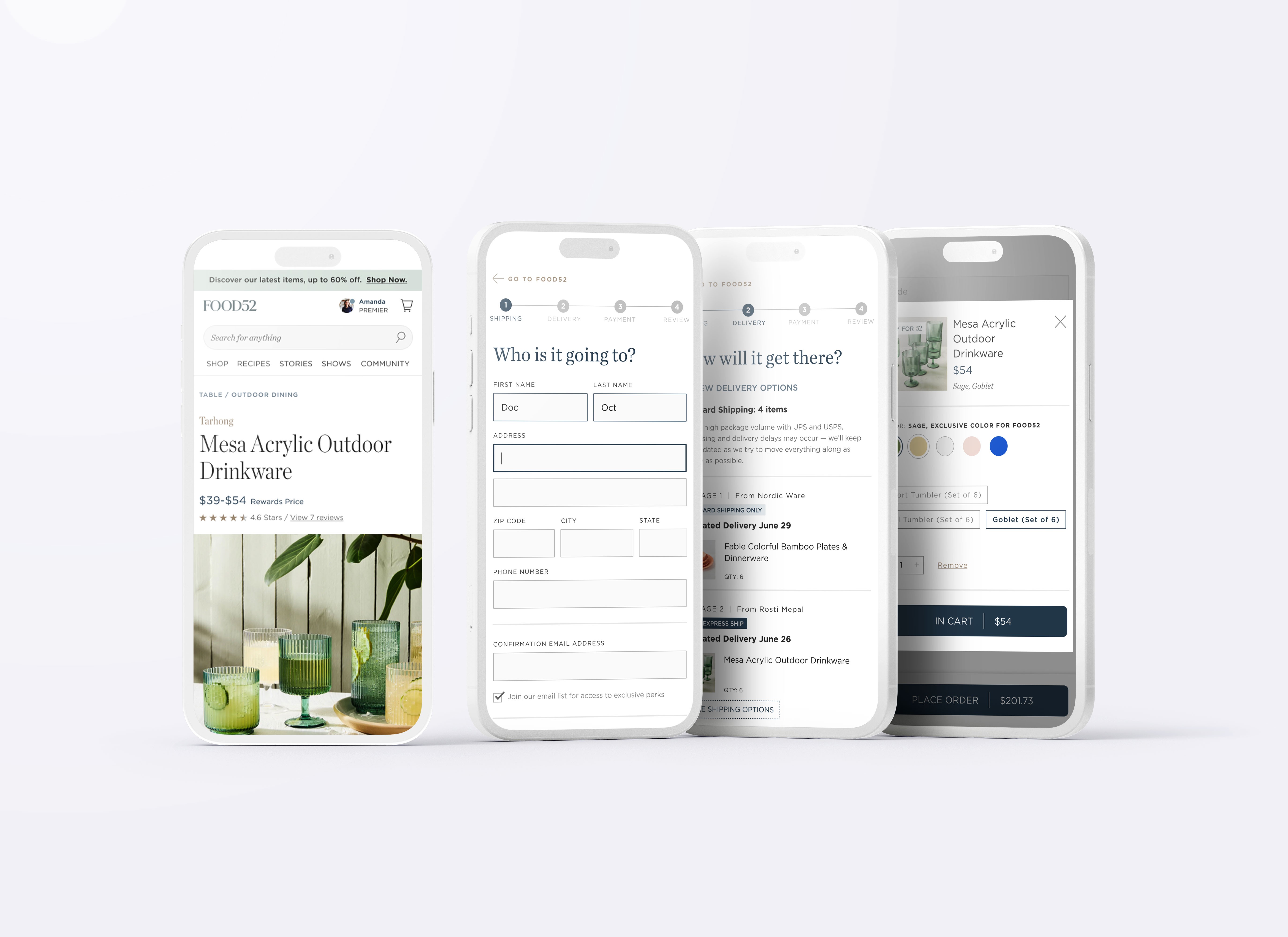
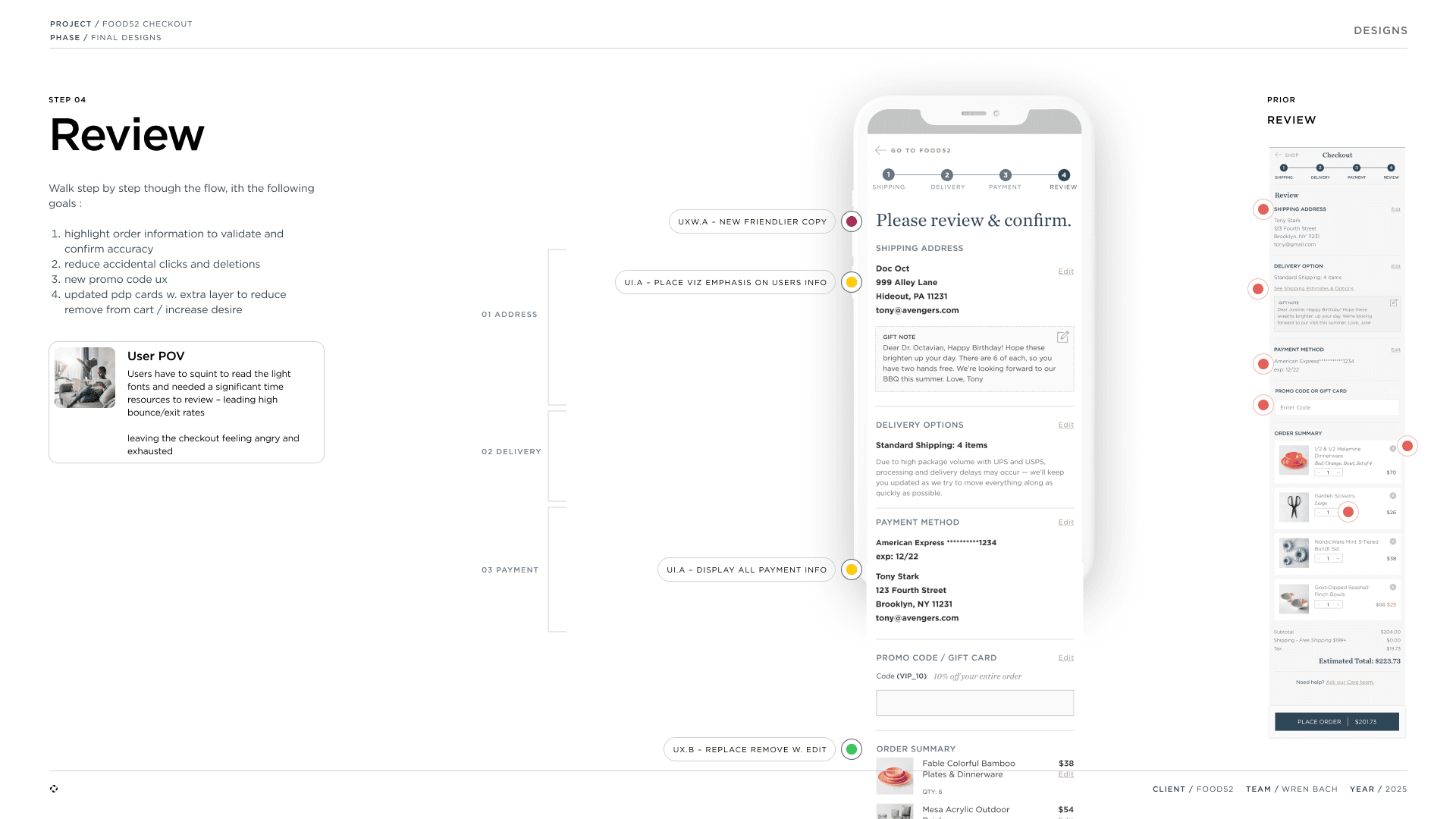
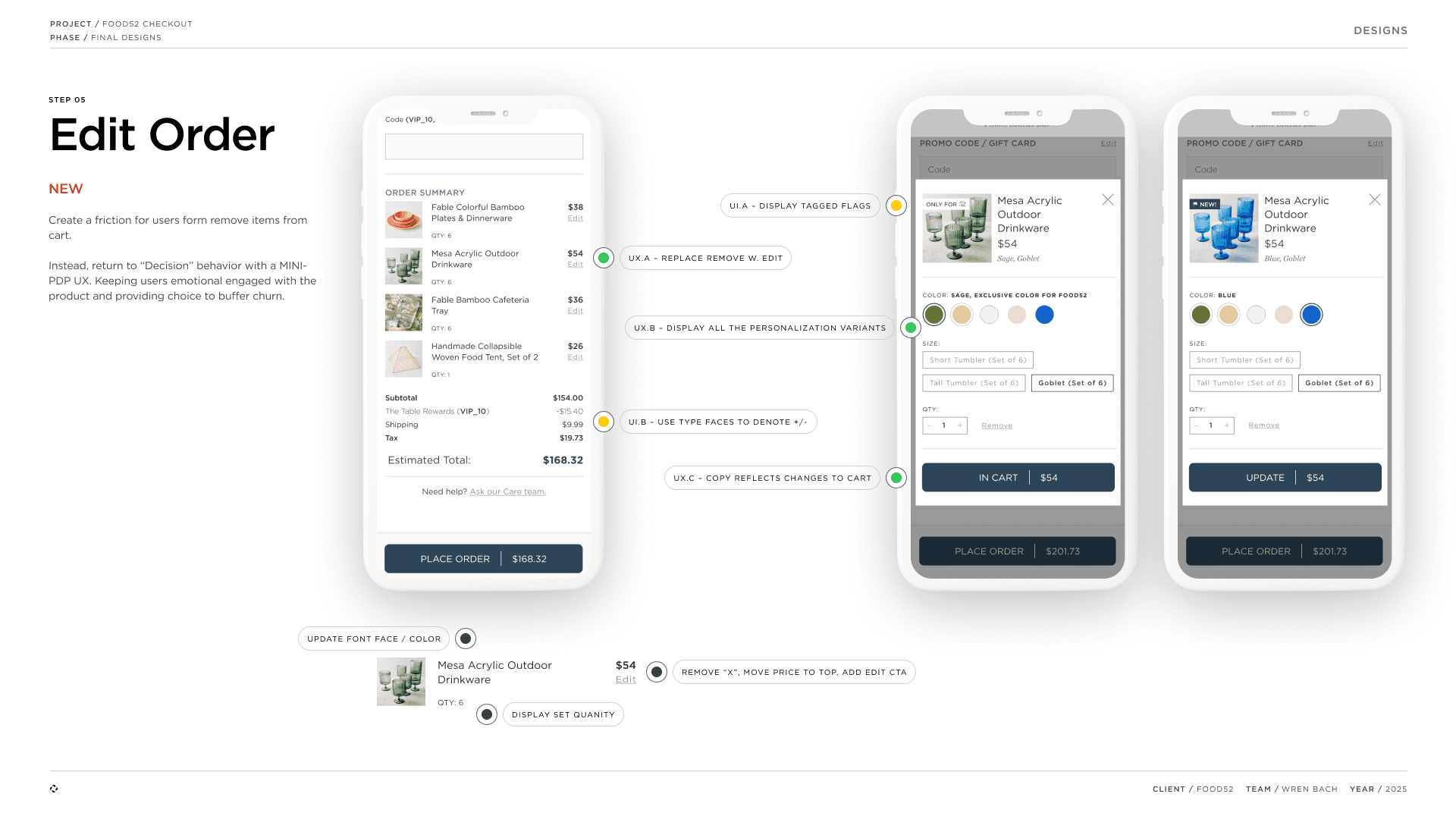
Refining the Funnel By applying Jakob’s Law, I introduced a familiar, modular modal system. This allowed users to edit orders without losing their place in the funnel, addressing a top friction point identified in user testing.
Intentional Friction We introduced a "gated" removal process. Instead of a mindless "Delete" action, we created a moment of reflection that reminded users of their choices. This paradoxical use of friction actually increased product retention and reinforced user confidence in the final checkout stage.
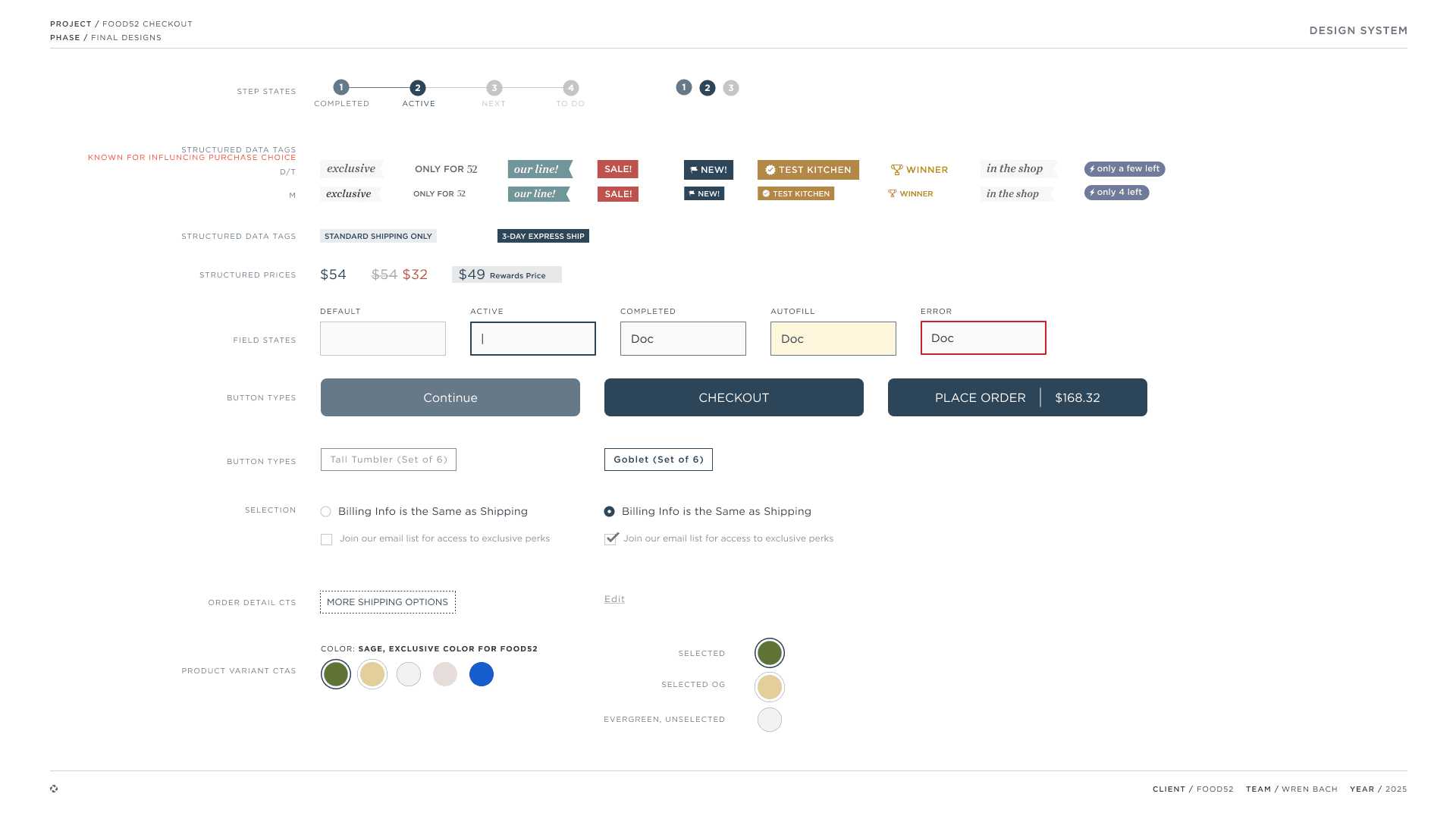
Systems Thinking: Accessibility & Scalability To ensure the new checkout could scale alongside Food52’s rapidly expanding catalog while maintaining WCAG 2.1 AA standards, I led a systemic audit of the core checkout components. I replaced legacy "one-off" UI patterns with a modular, token-based library that prioritized high-contrast color scales and accessible typography for increased readability. By engineering a suite of reusable components. From dynamic error-handling states to accessible payment modals, we created a future-proof framework that reduced design-to-engineering handoff time and ensured a consistent, inclusive experience.
The Outcome
The redesign didn't just modernize the UI; it validated a new internal standard for how Food52 handles complex logistics.
40% lift in purchase conversion.
15% reduction in cart abandonment.
100% W3C legal Compliance Score
Beta testers cited the "Edit Order" modal as the primary reason for their increased trust in the process.
Leadership & Strategic Reflection
Orchestrating Cross-Functional Alignment Beyond the UX/UI, my primary role was to bridge the gap between aggressive business OKRs and human-centric design. By leading the initial design sprint, I moved the conversation from "adding features" to "solving for trust." I facilitated a shared language between Product and Engineering (who needed clear component governance) and Marketing (who needed to maintain the brand’s luxury editorial feel.) This collaborative approach ensured that the final solution wasn't just a design handoff, but a product strategy that everyone was invested in.
The "Intentional Friction" Paradox. One of the most significant takeaways from this project was the success of the "Gated Remove" UX. While traditional e-commerce wisdom suggests removing all friction, we found that a moment of reflection actually increased purchase confidence. It taught the team that "frictionless" isn't always synonymous with "better." Sometimes, a purposeful pause is exactly what a user needs to feel secure in a high-consideration purchase.
Adaptive Personalization. Looking into how the checkout experience can dynamically shift based on user archetypes. Providing more educational "hand-holding" for first-time buyers while offering a "lightning-checkout" for high-frequency repeat customers.
The Opportunity
While Food52 saw high content engagement, the checkout experience was a point of significant friction. As users transitioned from high-end editorial content to a complex drop-shipping logistics flow, "purchase confidence" plummeted. I was tasked with evolving the UX to bridge the gap between luxury brand sentiment and functional e-commerce reliability.
To bring user-based conversations out of ambiguity and assumptions with executives, I created a mind-map diagram show how E-comm fit into the overall business as it accounted for 80% of our overall revenue.
The Problem
Our check was not being used. High bounce rates and churn within the checkout flow and a low retention rate, created an opportunity to iterate on the over all checkout experience.
We were driving users to the revenue flows but losing them in the conversion funnel.
Users did not trust our checkout because it broke the perceived (and well established) ux rules of digital shopping - creating doubt, second-guessing and abandonment. (lack of clarity, complex language, decision making when commitment should be the focus.)
The Users
"I need to just have blind faith that I will get what I am ordering"
I completed a 1 week interview sprint with users, applying a 3-dimensional framework to validate my theories
Primary focus on the new visitor (80% of visits) on mobile devices (85% of traffic). Through interviews and quantitative data, I quickly identified the key pain-points and validate my hypothesis based in user confusion in a common task workflow based on desired action and outcomes.
The Challenges
5-15% retention rates
$50-120 loss in checkout abandonment
15-20% completion rates
-28% W3C legal Compliance Score
The Strategy
To move from "blind faith" to "informed trust," I facilitated a cross-functional design sprint with Product, Engineering, and Marketing. We mapped the e-commerce ecosystem against five distinct user archetypes and identified four strategic pillars:
Transactional Clarity: Implementing a high-hierarchy "mini-funnel" (Identity, Shipping, Payment, Review).
Intent-Driven Content: Rewriting technical logistics jargon into human-centric, brand-aligned copy.
Systemic Refinement: Architecting an ADA-compliant design system to reduce cognitive load and visual noise.
Reduce Errors: Redesign UI elements to reduce confusion, errors and support desirability in exclusive purchases
The Execution
Refining the Funnel By applying Jakob’s Law, I introduced a familiar, modular modal system. This allowed users to edit orders without losing their place in the funnel, addressing a top friction point identified in user testing.
Intentional Friction We introduced a "gated" removal process. Instead of a mindless "Delete" action, we created a moment of reflection that reminded users of their choices. This paradoxical use of friction actually increased product retention and reinforced user confidence in the final checkout stage.
Systems Thinking: Accessibility & Scalability To ensure the new checkout could scale alongside Food52’s rapidly expanding catalog while maintaining WCAG 2.1 AA standards, I led a systemic audit of the core checkout components. I replaced legacy "one-off" UI patterns with a modular, token-based library that prioritized high-contrast color scales and accessible typography for increased readability. By engineering a suite of reusable components. From dynamic error-handling states to accessible payment modals, we created a future-proof framework that reduced design-to-engineering handoff time and ensured a consistent, inclusive experience.
The Outcome
The redesign didn't just modernize the UI; it validated a new internal standard for how Food52 handles complex logistics.
40% lift in purchase conversion.
15% reduction in cart abandonment.
100% W3C legal Compliance Score
Beta testers cited the "Edit Order" modal as the primary reason for their increased trust in the process.
Leadership & Strategic Reflection
Orchestrating Cross-Functional Alignment Beyond the UX/UI, my primary role was to bridge the gap between aggressive business OKRs and human-centric design. By leading the initial design sprint, I moved the conversation from "adding features" to "solving for trust." I facilitated a shared language between Product and Engineering (who needed clear component governance) and Marketing (who needed to maintain the brand’s luxury editorial feel.) This collaborative approach ensured that the final solution wasn't just a design handoff, but a product strategy that everyone was invested in.
The "Intentional Friction" Paradox. One of the most significant takeaways from this project was the success of the "Gated Remove" UX. While traditional e-commerce wisdom suggests removing all friction, we found that a moment of reflection actually increased purchase confidence. It taught the team that "frictionless" isn't always synonymous with "better." Sometimes, a purposeful pause is exactly what a user needs to feel secure in a high-consideration purchase.
Adaptive Personalization. Looking into how the checkout experience can dynamically shift based on user archetypes. Providing more educational "hand-holding" for first-time buyers while offering a "lightning-checkout" for high-frequency repeat customers.



“There is no reason that function should not be beautiful. In fact, beauty usually makes it more effective.” - Spock
2026© wren bach design studio & portfolio
available for projects / for hire
“There is no reason that function should not be beautiful. In fact, beauty usually makes it more effective.” - Spock
2026© wren bach design studio & portfolio
available for projects / for hire